Pages

Showing posts with label Great Western Sugar Mill. Show all posts

Tuesday, January 12, 2016

Sweet Sugary New Year

Sweet.
That sums up my start to the 2016 urbex year.
A couple years back, I hit up this location with a couple friends, but we had to beat a hasty escape as our exploring time was cut short when we ran into the owners.  How we were not seen or caught is beyond me, but we got out.  Ever since that day, I had always dreamed of returning and fully exploring this magnificent piece of Colorado history and of Colorado's urbex scene.
This is the Longmont Sugar Mill.
You cannot drive through eastern Longmont without noticing this beast.  The sprawling complex is easily seen from I-25, miles away.
Let's go back in time a bit, shall we?
Ground was broken for the mill in January of 1903.  A massive $1,000,000 investment kicked off construction.  This was an astronomical sum of money for the time, seeing as to how sugar beet mills only operated four months out of the year.  Longmont had very rich soil, making it an ideal location for sugar beets to be grown. Before the construction was even started on the mill, over 4,000 acres of sugar beets had been planted around the proposed location. There was some controversy surrounding the construction of the mill initially, as there was concern that there would be an over saturation of sugar factories around Longmont.
Once a compromise was reached, construction started on the Longmont Sugar Mill.  Here is an interesting piece of information concerning the construction of the mill from longmontian.blogspot.com, "The Longmont factory was the first in northeast Colorado to be funded exclusively with out-of-state capital, leading local factory organizers to remind Longmont citizens that the factory would not cost them a single penny."  The mill was built to handle 600 tons of processed beats daily, but there was a catch.  The mill was designed to be over built so that it could handle twice the initial capacity of sugar beats should it be necessary for the following seasons.  The mill was constructed by the Kilby Manufacturing Company of Cleveland, Ohio.  Only a couple years after construction, the mill was acquired by the Great Western Sugar Company, a company that would eventually own 15 sugar beet mills along the Front Range.
By 1920, sugar was the mainstay for Colorado, with harvest value almost 20 times what it was in 1900.   The Longmont Sugar Mill, in its heyday, was processing an unthinkable 2,500 tons of sugar beets DAILY. By using the simple equation of 1 ton of sugar beets = 300 pounds refined sugar, the mill was outputting almost 750,000 pounds of refine sugar a day. Wow!
To keep the refined sugar from sugar beats profitable, the Dingley Act of 1897 put a tax of $1.95 per 100 pounds of imported sugar.  This is effectively what kick started the building of sugar factories around Colorado.
The Longmont Sugar Mill employed 600 workers who worked around the clock to keep the mill flowing.  The mill also employed a 3,000 horsepower steam system. The steam system was harnessed through the entire mill via a complex system of pipes, levers, pulleys and more, and was the backbone that kept the sugar flowing out.  The mill also had it's own chemistry and assay departments, which would measure the sugar content of incoming beets.
Eventually, the sugar beet mills fell victim to imported cane sugar, and all but one of these great mills were shut down.  The Longmont Sugar Mill in particular closed it's doors for the last time in 1977.
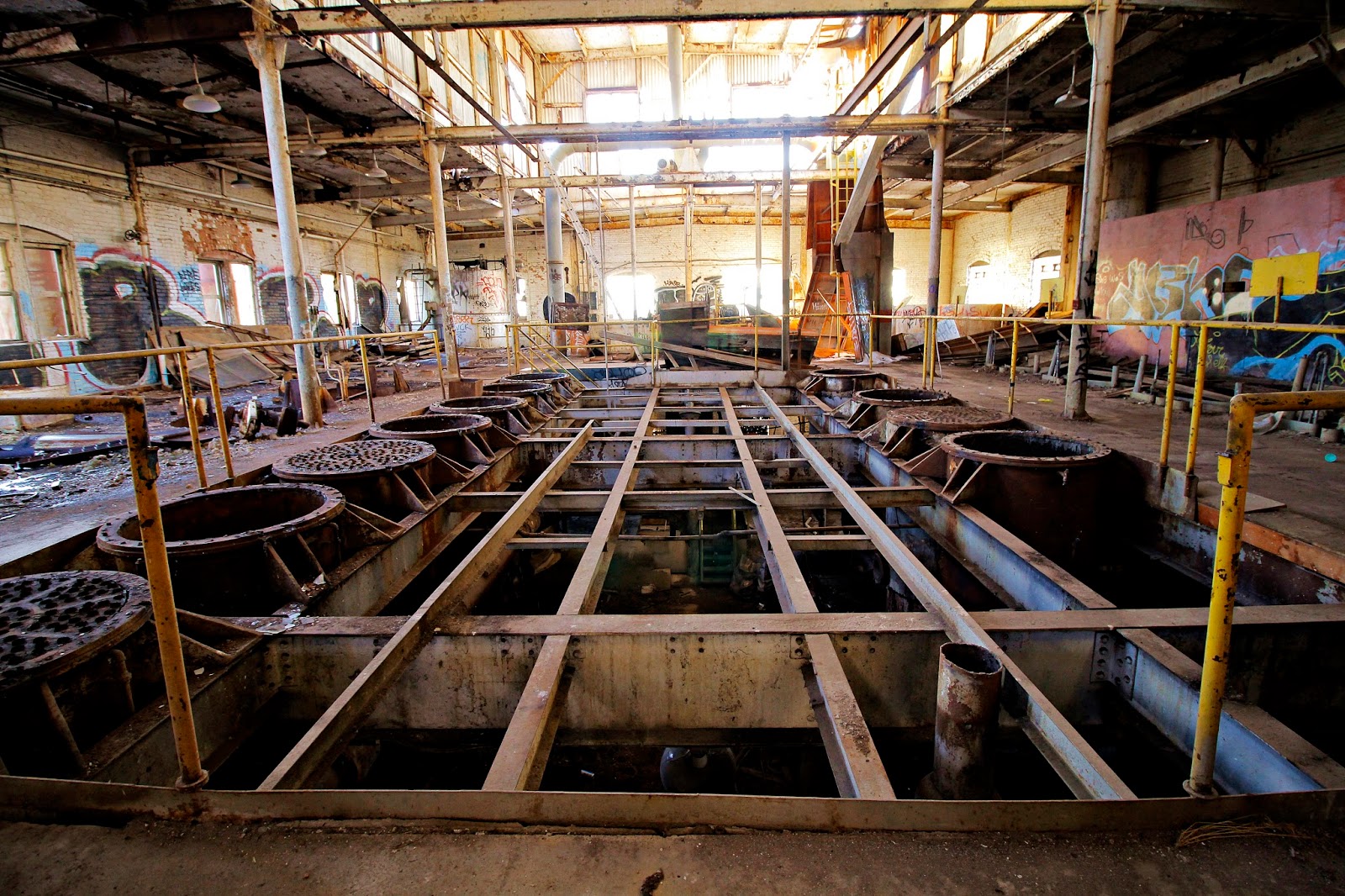
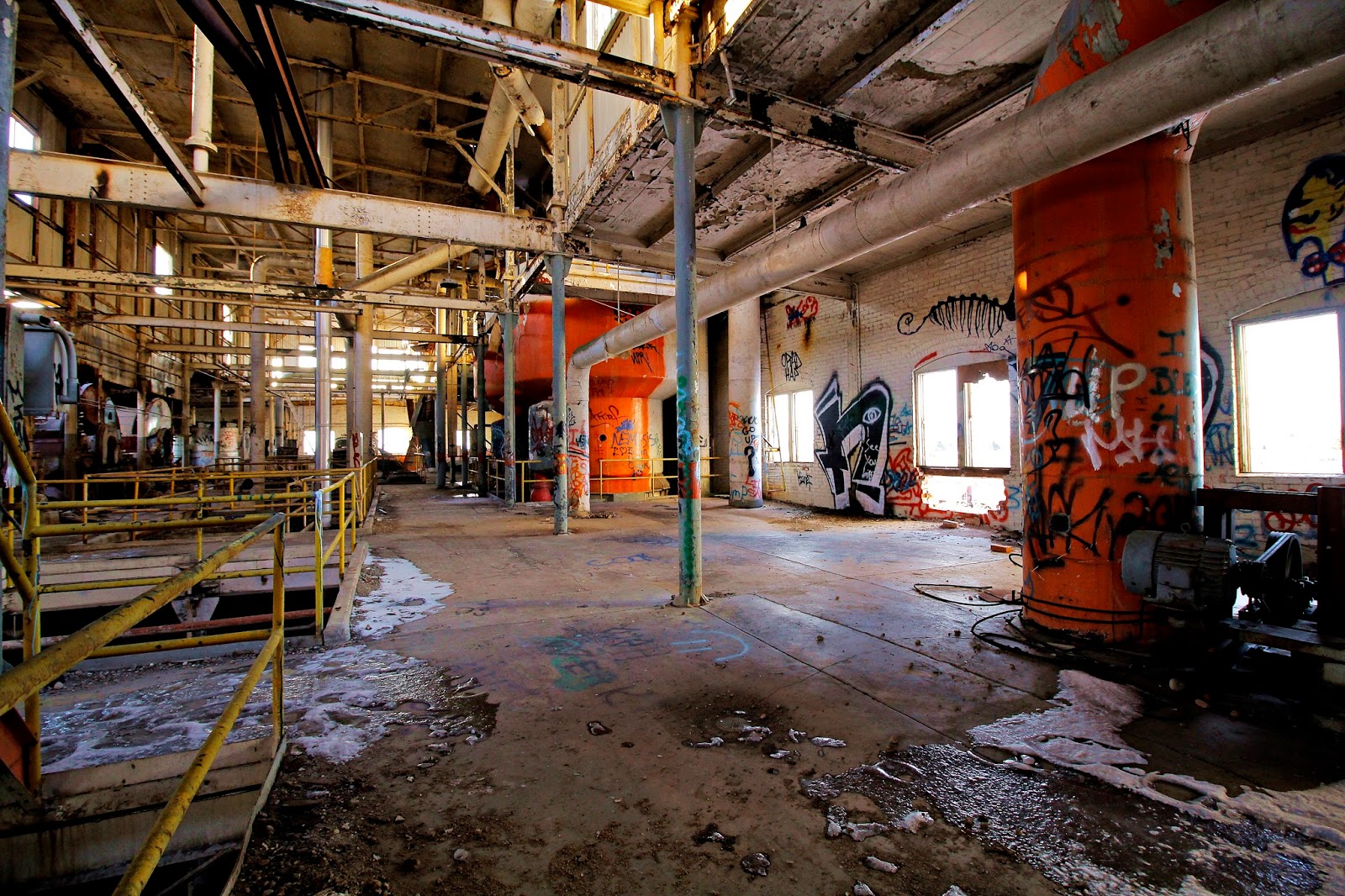
All that remains now is but a ghost of it's once magnificent past.  Empty buildings sit abandoned, the machinery housed withing, idle and quiet.  A eerie silence perforates the entire complex, as all that can be heard now are the echoing drippings of water, flapping of pigeons and the occasional creak as a breeze weaves throughout the maze of pipes and walkways.
My return trip to kick off this year was incredible.  I was finally able to explore the vast maze of pipes and walkways in the northern building.  This is the closest you can get in Colorado to the famed factories of the eastern U.S. Walking amongst the silent machinery, I couldn't help but imagine the controlled chaos and noise that the mill produced on a daily basis.  It is sad that this is one of only four sugar mills that remain standing in Colorado.  This place is one of the most incredible and awe inspiring locations I have ever visited.

Historic photo of the Longmont Mill: 


Map of the mill:


Photos from my exploration: 


Tuesday, December 1, 2015

Top 5 Favorite Locations

The colder months have fallen upon Colorado, and although that will not keep me from exploring, it definitely isn't my preferred weather to explore in either.   The holiday season has also befallen us, and that means busy times, long hours at work and visiting with the family, which means little time to get out and explore.  So, with that being said, I have decided to compile a list of my top 5 favorite locations that I have explored.

And, without further ado, here you go:


5. Magnolia Mill

One of my latest posts here was from my return trip to the magnificent and wonderful Magnolia Mill. Originally constructed in the 1860's, the current mill was built in 1910 to replace the original, which was lost to a fire.  The mill processed some of the richest ore in the region, processing millions of dollars of gold and silver.   Due to it's remote location deep in the Rocky Mountains, few people visit which means that the mill is in very good condition and has seen very little vandalism.  Hopefully the mill will avoid the fate of time and the hands of vandals for many years to come.
Video from my exploration: Urbex Colorado Episode 10- Magnolia Mill


4. Atlas D Missile Base

Back in April, I joined up with my best friend Dillon and our good friend Perspective Images Photography for an urbex day trip.  Leaving early in the morning and not returning till late in the evening, we traveled close to 200 miles through two states and hit up a multitude of abandoned locations.  The last location we visited has become one of my all time favorite spots. An abandoned Atlas D missile base.
This particular base, Site B of the 565th SMS, was operated by F.E. Warren AFB located out of Cheyenne, WY.  This base was built in a 3x3 configuration: three launchers and one combined guidance control/launch facility constitutes the complex. The missiles were housed horizontally above ground in "coffin style" complexes.  In order to launch, the 400 ton overhead door was rolled back and the missile would be raised to a vertical position. The missile would then be fueled and ready to launch. 
The original Atlas missile was designed in the late 1950s to be used as an intercontinental ballistic missile(ICBM) capable of delivering a nuclear warhead thousands of miles away.  The Atlas missiles only saw brief service as ICBMs, and the last squadron was taken off operational alert in 1965, though their use in the "Space Race" has been huge.  From 1962 to 1963, Atlas boosters launched the first four American astronauts to orbit the Earth. Various Atlas II models were launched 63 times between 1991 and 2004. There were only six launches of the Atlas III, all between 2000 and 2005. The Atlas V is still in service, with launches planned until 2020.
Missiles were retired and removed in September 1964 in favor of the more advanced LGM-25C Titan II.  The squadron was inactivated on 25 March 1965, and the missile sites were later sold off to private ownership after demilitarization. 


3. Longmont Sugar Mill

The Longmont Sugar Mill.  One of Colorado's iconic and most well known urbex locations.  And not the easiest place to explore either.   A sprawling complex that stands sentry over the city of Longmont, the site takes up 17.5 acres.  
Excerpt from Colorado Magazine Online: "Longmont, Colorado was home to one of the Great Western Sugar Companies sugar mills, where sugar beets were processed into refined sugar. The Longmont mill was built in 1905 and remained in use until 1980. The mill had its own rail yard and used a small steam locomotive to move railroad cars around the plant. Later, a small diesel engine was employed. Today the mill stand vacant and abandoned." 
According to owner Dick Thomas, there are no foreseeable plans in the future to do anything to the site.
Though a major attraction to those looking for adventure, bewarned.  The mill is a major health and safety risk(earlier this year a section of the brick wall collapsed) and the site is rife with asbestos.  If that doesn't stop you, keep in mind that the owners are on site often scrapping metal, and the adjacent businesses have been notified to alert law enforcement should they see anyone on property.


2. LA88 Nike Missile Base

What do you do when jet aircraft enter the war scene? You build missiles that can intercept them.  Proposed in 1944 to counter the threat of jet aircraft, Project Nike saw a total of 145 missile batteries commissioned to provide last ditch anti aircraft defense for major cities and military installation in the US.  When the US entered the Cold War, the Nike missiles turned their eyes towards protecting the mainland from Soviet nuclear missiles.  
Nike site LA-88, Oat Mountain, Chatsworth was one of 16 Nike missile sites located around Los Angeles to provide a 360 degree defense against nuclear laden Soviet bombers. Part of a steel curtain air defense, the bases motto was, "If it flies, it dies." The base consisted of an administration area and launcher area, with three underground launchers. 
LA-88 came online for full time duty on August 26, 1956, and served for 18 years before being decomissioned in 1974.
LA-88 was the first Nike base in the Los Angeles area to employ K9 sentry dogs to patrol the facility. 
LA-88 was also the first base in the Los Angeles area to convert to "Hurcules" nuclear war-headed missiles for use alongside earlier "Ajax" missiles, as a dual missile site with the extended range required for anti-enemy long range missile protetction. 
A wildfire in 1981 gutted and destroyed most of the buildings, and the grounds are currently used by local SWAT agencies for training and K9 training.
Here is a link with excellent information on the Nike missiles and this base: http://nikemissile.org/LA88/LA88.shtml


1. Titan 2B Missile Base

Out of all of Colorado's urbex spots, none can compare to the might and power of the Titan missile bases.   
The Titan missiles were ICBMs that stood ready to launch nuclear warheads far away.  Built during the Cold War, they were a formidable front line deterrent.  
An excerpt from missilebases.com: "The Titan I was the largest and most hardened of the first generation ICBM bases. Active from 1961-1965, they were to be used as our last deterrent and were capable of supporting 150 personnel for 30 days in a nuclear war scenario. Only 18 such sites were built at the incredible cost of $170 million dollars each"
Each base housed three missiles, each with it's own silo, multi-level maintenance bay and fuel terminal. A generator room, communications rooms and control room all served to keep the missiles at ready should the word ever sound.  
Though long abandoned, the missile bases have become a mecca for urban explorers. Their shear size and incredible history have made them one of the premier locations for urban explorers. I will never forget my times spent at this base.
Link for more reading: http://www.missilebases.com/#!titan-i/c1ypw